Let Muse show you how unified museum technology should feel. Book a Demo
Visitors judge your museum as a whole, not just the exhibits. Long ticket lines, confusing signage, staff responsiveness, or unexpectedly closed attractions affect whether they come back. They also shape what visitors tell their community. A museum visitor experience that keeps guests engaged from arrival to departure is key to turning guests into loyal visitors and strengthening their connection to your institution.
But creating an experience that works for everyone is hard, because no two visitors want the same thing. A family with young kids, a retiree with a membership, and a tourist visiting your city all walk through the same door with different expectations. Most of them won’t tell you what they’re looking for, and some don’t know until they find it or leave without it.
The good news is that you don’t have to guess. With the right approach, you can learn what your visitors need and build an experience that works for far more of them. In this guide, we’ll cover what museum visitor experience is, why it matters, how to tell when yours needs work, and the steps and habits that improve it.
Museum visitor experience FAQs
What is museum visitor experience?
Museum visitor experience is every interaction a person has with your museum, from when they first hear about it to the follow-up after their visit. It includes the elements you might expect, such as exhibit quality and guest service. However, many museums overlook the less obvious parts, like arrival, parking, and navigation, even though they shape how visitors feel about the whole visit.
Museum visitor experience generally breaks down into these categories:
Arrival and entry: How easy it is to find your museum, get there, park, buy a ticket, and get through the front door.
Navigation: Whether visitors can find their way around with signage, maps, and suggested routes, without getting lost or missing what they came to see.
Exhibits and programs: The quality of your content, how it’s presented, and whether it holds the attention of different audiences.
Service: How staff and volunteers greet visitors, answer questions, and handle problems.
Amenities and accessibility: Restrooms, seating, the café and shop, and accommodations for visitors with disabilities.
Communication: The information visitors get before they arrive and the follow-up they receive after they leave.
Why does museum visitor experience matter?
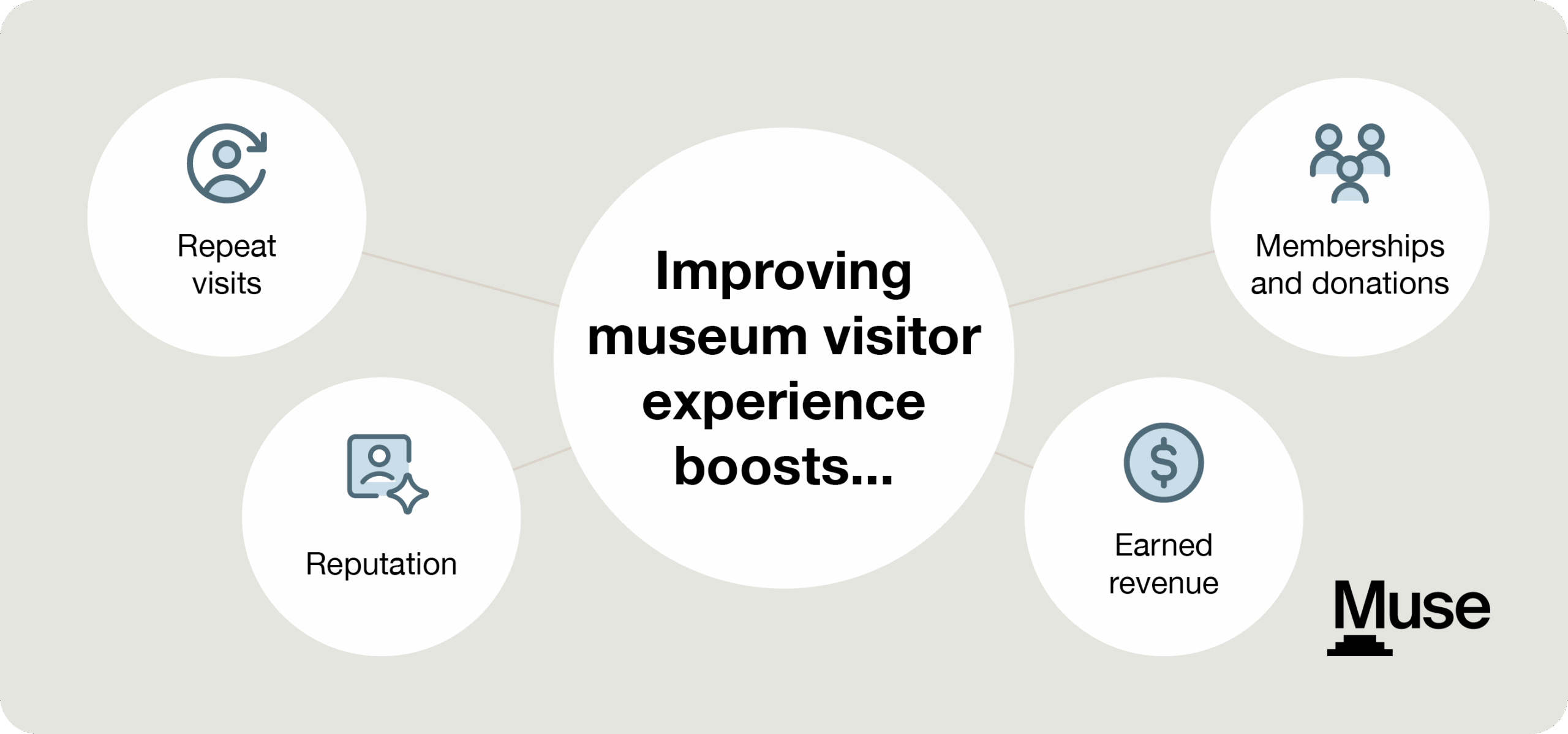
The visitor experience shapes how well your institution can fulfill its mission. Your curators and educators can build a brilliant exhibition, but a visitor who spent 20 minutes in the ticket line and another 10 looking for the right gallery isn’t in the best mood to appreciate it and the work that went into it.
Repeat visits: Satisfied visitors come back, and they bring their friends and family. Withmore than half of U.S. museums still seeing fewer visitors than they did in 2019, every return visit counts.
Memberships and donations: A great first visit often shapes whether someone decides your museum is worth supporting. Happy visitors are more likely to buy a membership, and members are one of your strongest pipelines for futuredonors.
Earned revenue: Comfortable, engaged visitors stay longer, and longer visits often mean more café and shop sales.
Reputation: People check reviews before choosing where to spend a free afternoon. One frustrating visit can become a public one-star review that sends future visitors elsewhere.
What are the challenges of ensuring a great museum experience?
Most museums work hard to improve their visitor experience, but these structural issues can get in the way:
Catering to diverse audiences: School groups, tourists, members, families, and researchers all need different things from the same building.
Limited staffing: When front-of-house teams are understaffed, they have less time to devote to visitor interactions and visitor experience projects.
Constrained budgets: Museums must allocate funding among conservation, exhibitions, facilities, and more, which can mean the visitor experience takes a back seat.
Fragmented data: When ticketing, membership, donations, and retail run on separate systems, you can’t see a complete picture of who your visitors are or what they do.
Modern expectations of convenience: Today’s visitors expect the same ease they get when booking a flight or ordering dinner on their phone. Slow or outdated processes frustrate them and can send them looking for other ways to spend their day.
Physical constraints: Historic buildings and fixed layouts make it hard to adjust wayfinding, accessibility, and crowd flow.
How do we know if our museum visitor experience needs improvement?
You might need to revisit your operations if:
Attendance is flat or declining, especially while similar institutions are growing
Few visitors return or convert to members
Membership renewal rates are dropping
Reviews repeatedly mention long lines, confusing signage, unhelpful staff, or overcrowding
Visitors leave quickly or skip entire galleries
Many people abandon your online ticket checkout before paying and ultimately never visit
Few homepage visitors click through to your ticket-buying page
Front-line staff receive the same guest complaints every week
Few people open post-visit emails or complete surveys
If you can’t tell whether these things are happening, you have a data problem. The right technology can close that gap, and we’ll cover what that looks like later in this guide.
How to improve your museum visitor experience
1. Use real data to understand your visitors
Your audience changes over time, so update your visitor data regularly to avoid relying on outdated assumptions. Focus on answering four questions:
Who visits? Break your audience into segments such as members, first-time visitors, families, school groups, and tourists. Each group wants something different from a visit, so knowing your mix tells you whose needs to design for and which groups you’re not reaching yet.
When do they visit? Look at attendance by day, time, and season to see when you’re busiest. This helps you staff the floor properly, schedule programs when people are actually there, and use timed entry to spread out crowds.
What do they do? Purchase history across tickets, programs, retail, and donations shows which visitors are most engaged. Someone who has visited five times and signed their kids up for camp is a much better membership prospect than a one-time visitor, so you’ll know who to reach out to with relevant offers.
What do they think? Post-visit surveys and online reviews tell you what visitors liked and what frustrated them, in their own words. Front-line staff and volunteers fill in the rest, since they often hear about problems well before those problems show up in a survey or review. Together, these show you which problems to fix first.
You’ll need the right tools to capture and act on all of this. A museum CRM combines each visitor’s tickets, purchases, memberships, and donations into one comprehensive record. That record lets you easily segment visitors and spot your most engaged ones. With everything connected, you can plan around the people who actually come instead of guessing.
2. Map the full visitor journey
Step into your visitors’ shoes to understand what you need to fix. Start with what visitors already tell you: satisfaction surveys, word-of-mouth trends, and patterns that repeat across separate reviews.
Beyond asking visitors directly, you can find helpful insights by going through the entire visit as they would. Assemble a small group of staff members across departments to look up your museum, browse the website, buy a ticket, find parking, arrive, and walk through the building. Write down every point where something is confusing, slow, or broken. They’ll likely see issues you might not notice from the other side of the ticket counter.
Once your team finishes the walk-through and compares notes, rank each problem by how many visitors it affects and how hard it is to fix. That ranked list will keep the rest of your work focused on the issues that matter most.
3. Remove friction from ticketing and arrival
For most visitors, buying a ticket is their first real interaction with your museum, and a clunky process can put them off before they’ve seen a single exhibit. To smooth the path from your homepage to your front door, you should:
Make buying tickets fast. Put a “Buy tickets” button on your homepage and every exhibit page, and keep checkout to a couple of minutes on any device, with no account creation or printing required.
Use timed entry to manage crowds. Timed tickets spread visitors throughout the day, so the lobby doesn’t jam at opening.
Send confirmation emails that do more than confirm. Include directions, parking, and hours so visitors arrive prepared.
Speed up entry. Let visitors with mobile tickets skip the purchase line, and let members check in with a quick scan of a digital card.
Fixing these issues is essential because ticketing is one of your main revenue streams and impacts every guest. The good news is, effective museum ticketing software handles most of these issues for both your team and your visitors.
4. Simplify wayfinding and layout
Your visitors can only have a great experience if they can find your exhibits. Good wayfinding feels so natural that visitors never think about it. To simplify navigation, you can:
Audit your signage. Check that signs are clear, consistent, and visible from a distance. Use the same gallery names on signs, maps, your website, and staff scripts, so visitors aren’t hunting for the “East Wing” when the map calls it “Gallery 3.”
Put maps where decisions happen. Place maps at every major intersection, staircase, and elevator, and clearly mark restrooms, seating, and exits.
Use landmarks and color. Color-coded zones and memorable landmarks (“turn left at the dinosaur skeleton”) help people orient themselves quickly.
Offer suggested routes with time estimates. A one-hour highlights route, a family route, and a more in-depth route let visitors with limited time or energy plan a visit that fits their schedule.
5. Improve amenities and facilities
Restrooms, coat checks, cafés, and shops might not be why people visit, but they shape how long people stay. Slow café lines and cash-only shops lose sales, and a 20-minute wait for a sandwich can sour an otherwise great afternoon. A modern retail and café POS speeds up checkout and links each purchase to the visitor’s record, so you can see which visitors are spending and on what. When connected to your membership data, it can also apply member discounts automatically, so staff don’t have to look up a membership at the register.
6. Make your museum accessible
Accessibility affects every part of the visit, and it deserves its own review. Answer the following questions to gauge your current approach:
Is our space ADA-compliant (wheelchair ramps, accessible restrooms, elevators, low counters, and wide doorways)?
How legible are our materials in terms of font size and color contrast?
Do our materials rely on only one sense to experience (e.g., a film without subtitles or an audio-only guide)?
Do we have sensory-friendly hours with reduced sound volume, brightness, and crowds?
Is our content only available in one language?
Does our website align with online accessibility guidelines such as WCAG (photos have alt text, videos have subtitles, site uses appropriate color contrast)?
The most reliable way to identify gaps is to ask visitors with disabilities directly and have a third-party auditor assess your space. Publish your accessibility details on your website, too, so people can plan their visit with confidence. Many of these changes help all visitors enjoy your collection more, not just those with disabilities.
7. Train and empower front-line staff and volunteers
Staff and volunteers have a large impact on how visitors rate their visit. Train them on the collection’s context, recognizing visitors’ needs, handling complaints, and following standard operating procedures.
As they get more comfortable, enable them to fix small problems without a manager’s approval, such as giving a free coffee to someone who waited too long. A quick fix in the moment can turn a frustrating visit into a reason to come back.
8. Design exhibits for different preferences and attention spans
Long walls of text tend to lose visitors, no matter how good the content is. The fix isn’t cutting content but presenting it intentionally so visitors can experience your collection in the way they prefer:
Lead with the hook. Start each section with a short, conversational headline that explains why the object or exhibit matters, and put the details below it for anyone who wants more. Cut jargon unless you explain it.
Spark conversation. Many visitors come in groups and learn by discussing your collection with others. Labels that ask questions (“What do you notice about the items?”) get people to look more closely and talk about what they see.
Add interactive, multisensory elements where they fit the exhibit. For instance, a music museum might use a listening station that plays the sounds of an instrument on display.
Plan for museum fatigue. Spread standout pieces throughout the visit rather than front-loading them, and break up long galleries with benches and quieter spaces.
Offer multiple guide formats, such as audio, print, and digital, so visitors can choose how they prefer to learn.
When planning your own exhibit improvements, look for specific types of museum technology, such as mobile guides, interactive displays, and augmented reality, to add dimension to your strategies. Just ensure your tech supports your exhibits instead of distracting from them.
9. Expand programming
Programs give visitors a reason to return and keep learning at your museum. Lectures, guided tours, workshops, family days, after-hours events, camps, and member previews also bring in people who wouldn’t come for exhibits alone.
Track who attends your programming so you can invite them to similar events later. Software for managing museum programs handles scheduling, capacity, and registration in one place, reducing manual work.
10. Follow up after the visit
Sending a thank-you email within a day or two of the visit builds goodwill and gives you useful feedback. Use what you know about their visit, like what they came to see and when they stopped in, to tailor the message. Include a note about what they saw, an invitation to an upcoming event, and a short survey that will inform future improvements.
Once you’ve made that first touchpoint, you can start marketing entry-level next opportunities while the visit is still top-of-mind, like returning for an upcoming exhibit, attending a specific event, or upgrading to a membership.
Other best practices for maintaining museum visitor experience
Improving the experience is one thing. Keeping it strong year after year, through staff turnover, new exhibitions, and changing audiences, takes a few good habits:
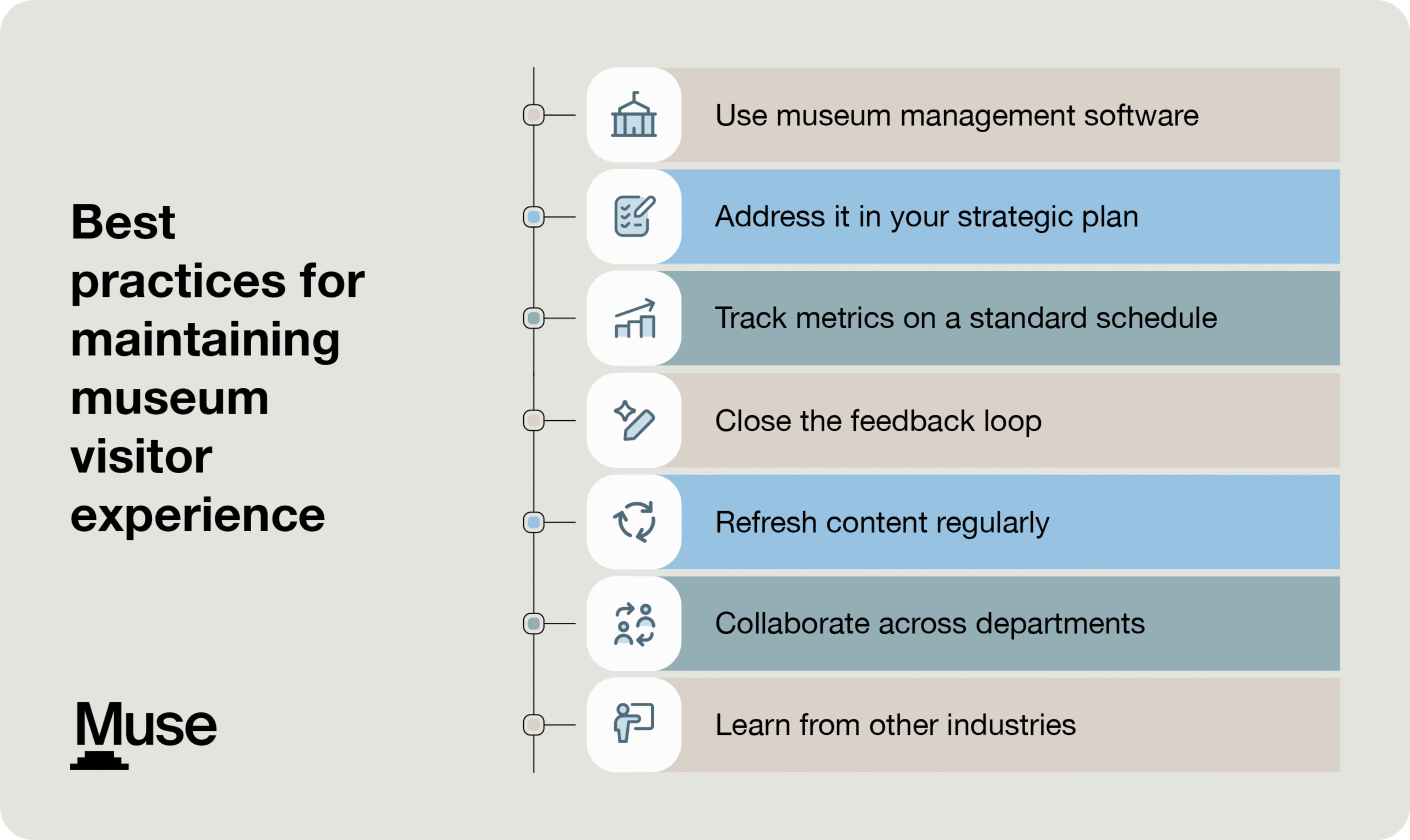
Use museum management software like Muse to connect every touchpoint. Many visitor experience problems are easier to solve when data flows freely across your institution. Muse bringsticketing and admissions,CRM, memberships, programs, retail, and fundraising together in one platform, with one record for every visitor, member, and donor. It’s designed to give visitors a faster, more consistent experience and give your staff the data they need to keep improving it.
Address visitor experience in your strategic plan. Assign goals, owners, and a budget to your museum’s strategic plan so it gets steady attention rather than only coming up after a wave of complaints.
Track the same metrics on a set schedule. Pick a handful of key performance indicators, such as satisfaction scores, review ratings, repeat-visit rate, and membership conversion, and check in on them monthly or quarterly to get a consistent view of your progress.
Close the feedback loop. When visitors or staff report a problem, fix it and let them know it’s fixed. Guests notice when you listen, and they’re more likely to come back.
Refresh content regularly. Rotate small displays, spotlight different objects, and update programs each season, so members still find something new every visit.
Collaborate across departments. Every department, from curatorial to front-of-house to development, shapes the visitor experience. Regular cross-department check-ins keep one team’s decisions from creating headaches for another.
Learn from other industries. Hotels, theme parks, and retailers have spent decades figuring out hospitality, crowd control, and personalization. Look at how they handle the guest experience and adapt what fits your museum.
Wrapping up
There’s no such thing as a perfect museum visitor experience, and honestly, that’s a good thing: it means there’s always another way to make a visit better. By staying open to new ideas and listening closely to your visitors, you’ll keep finding small ways to make each visit a little more memorable than the last.
Learn more about museum management with these free resources:
Museum fundraising tips: How to raise more and engage donors. You can turn everyday visitors into loyal donors by mapping your donor lifecycle and using your museum’s unique assets. Read the guide to start building a steadier fundraising pipeline.