Stop letting outdated technology hold your institution back. Request a demo.
Consider all the unique aspects of your museum. From ticketing to programming to membership, your organization has many revenue streams and supporters to manage. That’s why data silos, uncentralized systems, and inadequate tracking can significantly harm your ability to view your standing and identify growth opportunities.
Unfortunately, many institutions are currently using outdated legacy systems or disparate tools that prevent them from reaching their full potential. That’s where a holistic constituent relationship management (CRM) platform becomes essential.
In this guide, we’ll explore the core mechanics of these systems, how to get started, and our pick for the top museum CRM to empower your organization’s expansion.
Museum CRM FAQs
What is a museum CRM?
A museum CRM is a software solution that serves as the core database and management platform for your organization. This type of platform tracks all constituent interactions and engagement activities to drive long-term revenue growth (which, for museums, might look like increasing attendance or membership conversions).
What are the best museum CRM features?
Not all museum CRMs have the same tools. The following features make CRMs scalable and useful across the board:
Unified constituent profiles. Consolidate visitor, member, and donor data into a single database to track every interaction in dedicated profiles.
Integrated ticketing, point of sale (POS), and capacity control. Centralize online and on-site sales and manage crowds with timed-entry tools and ticketing bundles to create a seamless entry experience.
Proactive AI and predictive analytics. Use AI-powered assistants to forecast attendance trends or identify at-risk memberships.
Strategic fundraising and moves management. Maximize development efforts with built-in tools for donor pipeline tracking, major gift cultivation, and prospect identification.
Operational sync and financial reconciliation. Connect disparate revenue sources such as retail and programming funds directly to your CRM, automatically syncing data with accounting platforms.
These qualities provide a good baseline, but consider your organization’s own unique needs, as they will impact other non-negotiable features to look for.
What qualities should we look for in a museum CRM?
While features are the specific tools your CRM offers, these are the larger strategic benefits to consider:
Scalability. Your museum software ideally allows your institution to expand specialized tools as your organization and the underlying technology evolve, rather than being locked into a restrictive legacy platform.
Privacy-first compliance. Prioritizing data compliance protects your organization against breaches and secures supporter data. Check your local data laws for more information, but your system should at least adhere to PCI standards.
User-friendliness. Look for platforms that empower non-technical staff to build custom workflows and reports without waiting on an IT department.
Vendor collaboration. The vendor should offer implementation support and comprehensive training resources that speak to the unique challenges museums face.
What are the challenges of implementing a CRM for museums?
Upgrading a core operational system carries inherent logistical and cultural risks, such as:
Poor user adoption. If your team isn’t on board with your new solution, they’re less likely to integrate it into their own workflows. This disconnect can cause even more confusion and further bog down workflows, not to mention damage ROI.
Data migration. Transferring clean data from multiple disconnected, outdated legacy systems into the new CRM is highly intensive. Misstepping during this stage can displace essential information you need to function. Make sure you select a provider that will assist you in the migration and implementation.
Change management. Between leading team-wide workshops, migrating data, and conducting ad-hoc training, the process of implementing new software itself can be disruptive for staff members.
Total cost of ownership. Costs frequently extend beyond recurring monthly licensing fees to include essential third-party integrations, external consultants, and other fees. To avoid redundant costs, choose an all-in-one platform.
Though implementing software can be daunting, don’t let these risks dissuade you from enhancing your tech. Being aware of the associated risks beforehand helps you prevent issues before they happen, making your investment well worth it.
How do we choose a CRM?
Though flashy features can be tempting, selecting the right platform requires focusing on long-term museum goals. Here’s how to choose the ideal platform for your needs:
Conduct a needs assessment. Evaluate the root causes of your biggest pain points and define future-state requirements that align with your big-picture goals. For instance, you might find that your main point is messy data systems due to a lack of integrations, making your ideal future state a centralized, integrated CRM.
Consider key evaluation pillars. Assess system candidates based on your goals and current state. For example, a smaller museum will likely have to consider its budget, whereas a larger museum might prioritize scalability.
Collect stakeholder buy-in. Since your CRM will impact almost every aspect of your operations, secure approval and input from the board and all key decision-makers early in the evaluation process.
Try demos and compare offers. Schedule demos for each solution that has made it through the first three stages. During this process, collect quotes from vendors. That way, you know if the CRM will be a good fit before committing and if you’re getting a good deal.
Addressing these foundational questions early ensures that the entire organization is aligned on the technical and operational goals of a new system before signing a contract.
Benefits of using a museum CRM
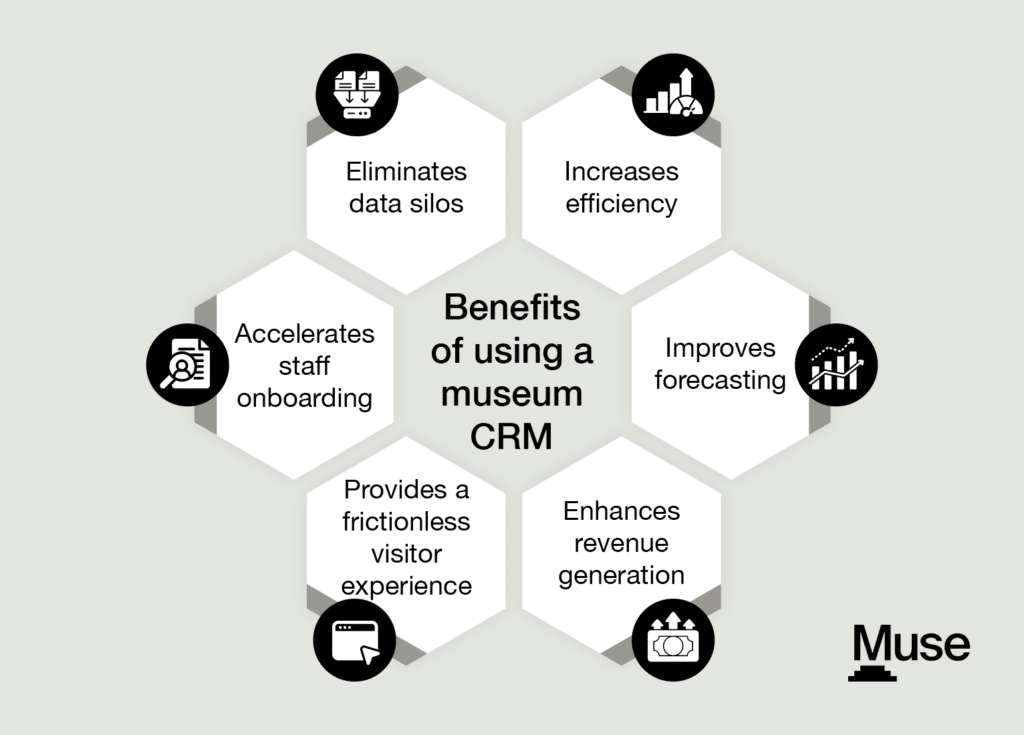
CRMs provide the fundamental architecture on which your museum can build its entire tech stack. These other advantages make using a museum-specific CRM a no-brainer:
Eliminates data silos. Achieving a unified constituent record for visitors, members, and donors ensures no relationship falls through the cracks.
Increases organizational efficiency. CRMs with automation capabilities streamline manual tasks, like sending emails or reconciling data, saving hours of valuable team time. In fact, Nonprofit Tech Shop found that organizations using CRMs experience 29% higher productivity and 42% better forecast accuracy.
Improves forecasting. The real-time data from a museum CRM provides better visibility for strategic planning so you can make data-driven decisions quickly.
Enhances revenue generation. Not only do CRMs empower better fundraising results with enhanced insights for relationship building, but they can also provide the infrastructure required to collect payments, like processing recurring donations.
Provides a frictionless visitor experience. Front-of-house staff can quickly access visitor history and membership status, ensuring fast admissions and personalized service. For example, if they notice a lapsed member is returning to the museum after a year, they can personally welcome them and let them know about any upcoming member promotions.
Accelerates staff onboarding. Intuitive, user-friendly platforms allow you to train new staff in hours instead of weeks, minimizing overall disruption and ensuring higher user adoption.
Ultimately, the primary benefit of a unified museum CRM is organizational clarity. When leadership can trust their data and execute tasks easily, they can confidently make decisions that secure the museum’s future.
Best practices for using a museum CRM
Once you’ve decided on a museum CRM, follow these best practices to ensure you’re leveraging it to its fullest potential and mitigating risks:
Prioritize tech and data governance
Shadow tech use occurs when staff members use tech outside of its specified purpose (or don’t use the correct tech at all). For instance, a staff member might use a personal spreadsheet to track potential donors instead of the official CRM, leading to more data silos and inefficiencies. Establishing data governance prevents shadow tech use by providing best practices and stipulations for your tools.
For museums, your data governance policy might include:
Clearly-defined data roles and ownership
Access controls
A strict list of permitted and prohibited tech use cases
Metadata formatting standards
Continuous monitoring and policy enforcement
Consider using AI and automation
AI is increasingly widespread in the museum world, and the best CRMs are incorporating intelligent systems. AI in museum CRMs can:
Autonomously qualify donor prospects
Create reports quickly
Leverage predictive analytics to forecast future trends
Draft tailored donor proposals
Handle routine constituent follow-ups
Suggest optimal visit times or exhibit-specific invitations based on live data
Trigger membership renewal automatically
Just ensure that, as you implement AI, you keep ethical considerations in mind and strictly prohibit shadow AI use.
Make operations mobile-friendly
Your visitors already use their mobile devices for almost every other part of their daily lives, and they expect the same convenience from your institution. Consider these mobile-friendly upgrades to legacy museum operations:
Move membership cards and tickets to digital wallets, like Apple or Google Wallet
Implement self-service constituent portals for membership renewal or ticket-buying
Use mobile POS tools
The top museum CRM: Muse
Muse is the ideal museum CRM because it provides a seamlessly unified constituent record, powerful agentic AI recommendations, and an incredibly intuitive interface. Unlike complex, generic legacy systems, Muse offers rapid implementation, native core operations features, a museum-specific focus, and transparent pricing. Our key features include:
Legacy Systems
The Muse Approach
Disconnected data silos and shadow IT
Unified constituent records that consolidate every touchpoint into a comprehensive profile
Reactive, surface-level reports
Engagement tracking and scoring that reveals hidden opportunities for major gifts and long-term membership growth
Months-long, expensive consultant setups
Fast onboarding so your museum can begin seeing measurable ROI in weeks, rather than months
Requires expensive third-party plugins
All-in-one operations hub that natively integrates ticketing, POS, and fundraising into one ecosystem
Hidden consulting fees and modular pricing
Transparent, all-inclusive pricing that helps your team plan for sustainable future growth
Check out our full list of features to see how an integrated ecosystem can transform your daily workflows.
Wrapping up
By embracing a unified museum CRM, your organization can eliminate structural inefficiencies, automate administrative burdens, and pinpoint actionable insights. Prioritizing a system built specifically for cultural workflows ensures that your staff spends less time wrestling with data and more time advancing your museum’s core mission.
Stop letting outdated technology hold your institution back. Request a demo below.