Let Muse show you how unified museum technology should feel. Book a Demo
Running a museum means managing several businesses at once: a ticketing box office, a retail store, an events venue, and education programs, just to name a few. Generic nonprofit strategic planning advice rarely accounts for that complexity, leaving a real gap between the plan on paper and how your institution actually operates.
That gap often surfaces at implementation. A typical strategic plan sets goals for the mission and budget, but rarely maps out how ticketing, membership, and donor data are supposed to work together to actually hit them. Institutions that close that gap build their strategy around that multifaceted reality from the start.
This guide covers what a modern museum strategic plan needs to include, along with the best practices that make it possible to execute.
FAQs about strategic planning for museums
What is a strategic plan for a museum?
A museum strategic plan is a documented roadmap for where your institution is headed and how you’ll get there. It typically covers your mission and programming priorities, as well as your operations, including your technology, revenue strategy, and visitor experience. Covering all these aspects keeps the plan tied to what your institution actually does well, not just what it hopes to do.
Why is strategic planning important for museums?
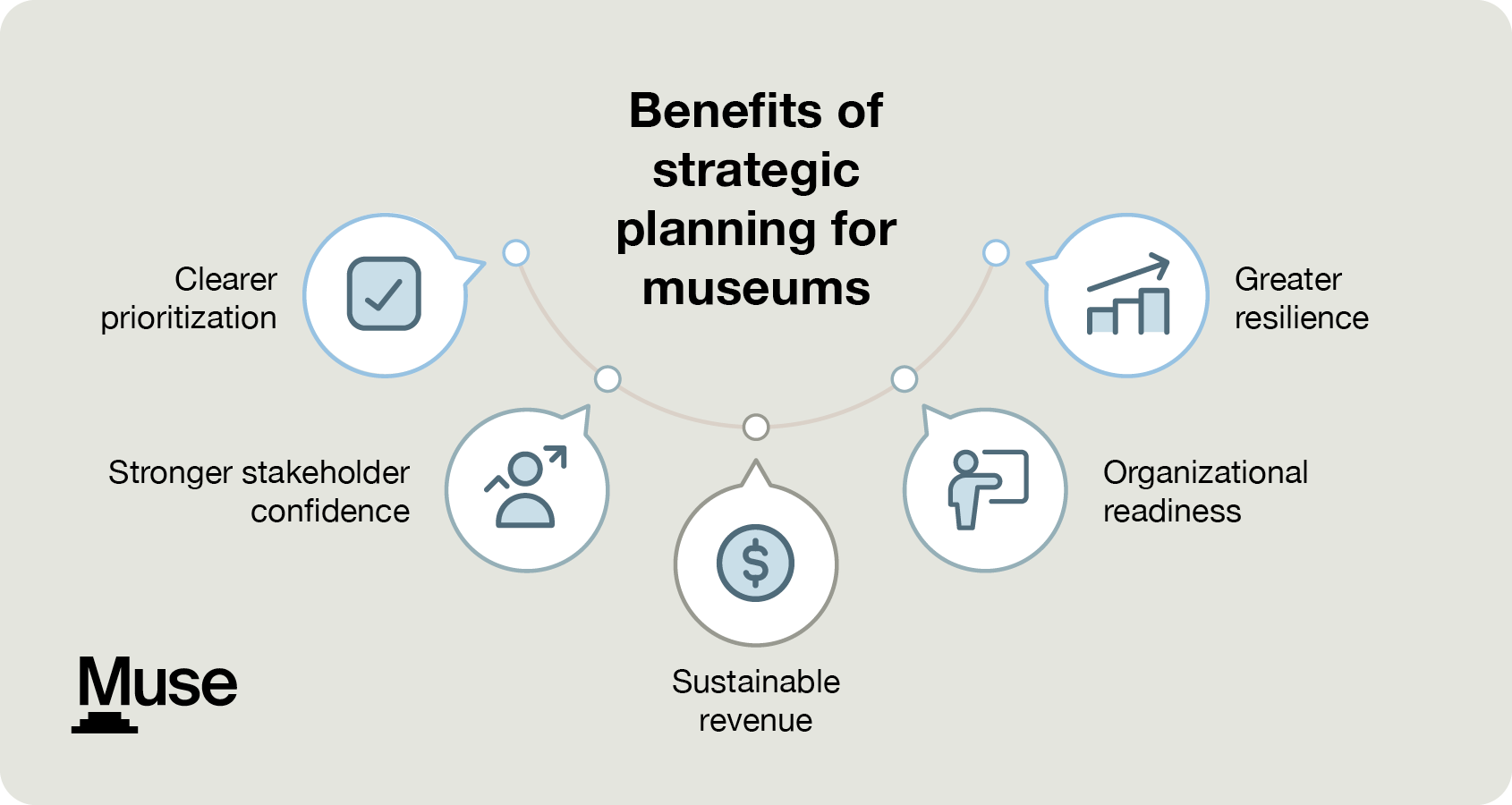
Museums need to have a strategic plan to weather long-term changes while staying on track to achieve their daily goals. Some of the biggest benefits include:
Clearer prioritization. For museums with limited budgets and staff time, a plan gives leadership a data-supported way to decide what gets funded first.
Stronger stakeholder confidence. Trustees, grantmakers, and staff respond better to decisions clearly tied to a larger strategy. Also, when day-to-day work is visibly connected to a larger institutional goal, staff are less likely to burn out from constantly reacting to whatever’s most urgent that week.
Sustainable revenue. A strategic plan forces leadership to consider earned revenue (ticketing, retail, rentals) and contributed revenue (donations, grants) side by side rather than reviewing them in separate budget conversations. That combined view enables forecasting by showing leadership where the museum is over-reliant on specific revenue streams.
Organizational readiness. Institutions with the right infrastructure in place can act on early warning signs, like a dip in membership renewals, instead of noticing the problem months later in an annual report.
Greater resilience during disruption. Conditions can shift quickly, whether that means a funding cut, a slow field trip season, or a bad winter for tourism. A strategic plan gives leadership something concrete to work from instead of deciding in the moment.
How often should a museum update its strategic plan?
Most institutions review their strategic plan annually to account for shifts in philanthropy or financial conditions. However, technology and operations overhauls (e.g., implementing a new ticketing system) are bigger undertakings, and typically happen every three to five years to keep systems aligned with how the institution’s multi-business operations have evolved.
Who should be involved in the museum strategic planning process?
While every museum has different teams and decision-makers, your strategic planning process might look like this:
Leadership:
The Board of Trustees ensures mission alignment, provides governance oversight, and approves the final plan and budget.
Executive leadership sets the overall vision, establishes strategic priorities, allocates resources, and leads the planning process.
Staff departments:
Operations and visitor services pinpoints front-line bottlenecks and provides data on visitor flow, ticketing tech, and daily logistics to improve visitor experience.
Development and membershipassesses donor capacity, aligns goals with fundraising capabilities, and identifies development opportunities.
Curatorial and education aligns future exhibition and collections strategies with the plan and designs community outreach and educational initiatives.
Retail and auxiliary services identify additional revenue opportunities to maximize visitor spend.
Other stakeholders:
Community ambassadors (e.g., volunteers and docents) provide external feedback on public perception, accessibility, and regional relevance.
Short- and long-term focuses. For a strategic plan to be useful, it needs to speak to your current priorities and vision for the future.
Alignment with the museum’s mission. Every goal in the plan should trace back to your core mission to prevent drift.
A summary of the planning process itself. Documenting who was involved, which stakeholders were consulted, and what challenges came up gives the plan context and credibility, both internally and with funders or accreditors.
Coverage of all relevant areas of museum operations. This is broader than most people expect: staffing, collections, facilities, education programs, marketing, technology, and all revenue lines should appear somewhere in the plan, not just the areas leadership finds most urgent.
Clear goals, strategies, and action steps. This is the most comprehensive section of the plan. It should break broad goals into specific steps, with details on what’s being done, who’s responsible, and by when.
Identified resources for each action step. A goal needs a corresponding budget or staffing plan to become fully feasible.
Assigned responsibility. Every action step needs an owner, whether that’s a specific person, a department, or a committee.
A way to measure success. Whether it’s attendance growth, membership retention, or a fundraising target, each goal needs a defined way to know if it worked.
Formal approval from the governing authority. The plan should include a date and sign-off from the museum’s board, which is what makes it an official institutional document rather than an internal working draft.
Plans vary widely between institutions, since a five-person historic site and a 300-person urban art museum won’t have the same planning needs, but these general benchmarks help nearly every type of museum.
Best practices for museum strategic planning
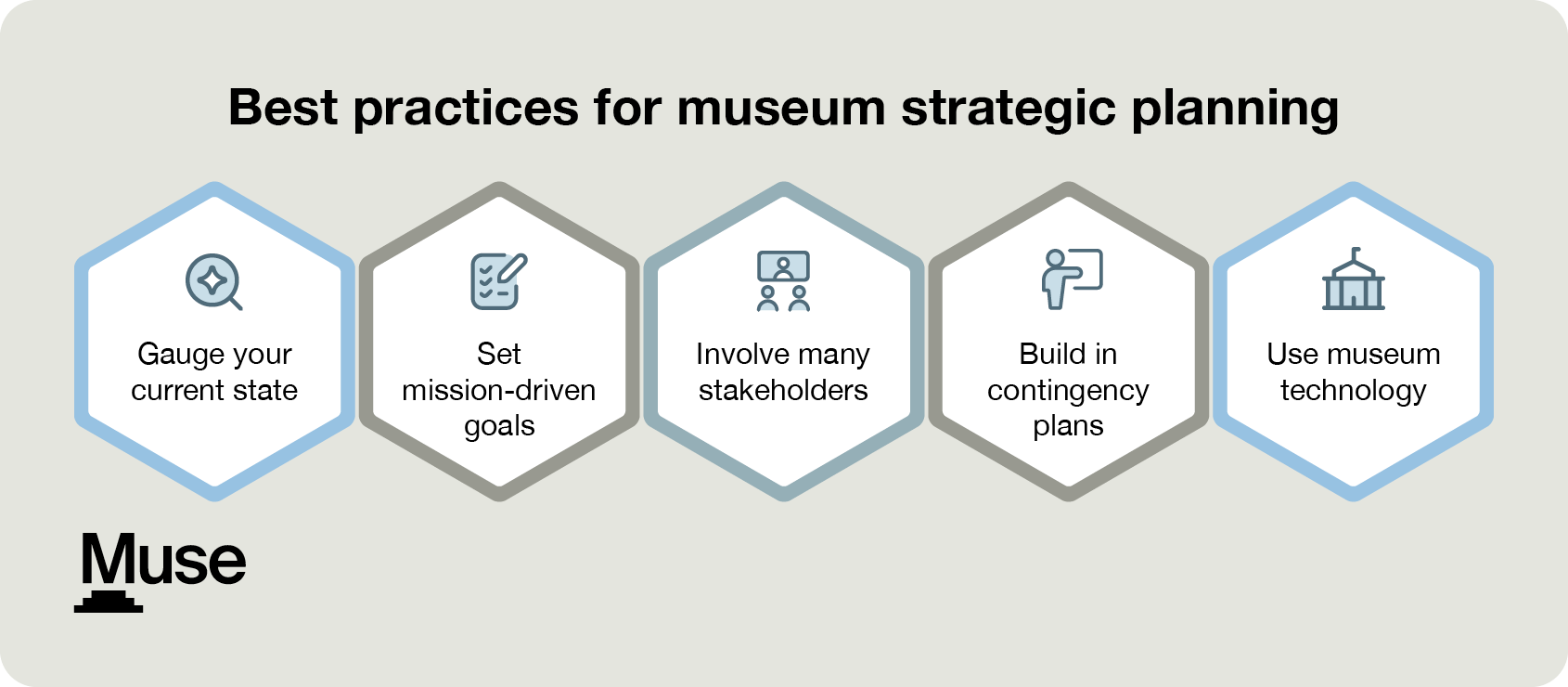
Gauge your current state
Museum boards often start planning by talking about what the institution wants to become without considering where it currently stands. A clear read on where you stand today is what keeps the rest of the plan realistic. Get started by:
Analyzing internal and external factors. Conduct a SWOT analysis (a matrix that determines your strengths, weaknesses, opportunities, and threats) to surface gaps in your strategy before rolling anything out.
Modeling the numbers. Test your strategic goals against staffing costs, capital needs, and financial projections before finalizing a plan. That way, you only take on initiatives that make sense financially and capacity-wise.
Checking your revenue streams. If one source, like a single major donor or ticket sales alone, makes up most of your income, that’s a risk worth addressing directly in the plan, not something to leave for the finance team to sort out later.
Set mission-driven goals
Specific goals with clear ownership make a strategic plan truly actionable. For instance, convert vague goals like “increase membership” into something your team can execute by attaching a target, a timeline, and a name. Some best practices to consider:
Name a metric and an owner for every goal. Attach a metric, like renewal rate, attendance growth, or donor retention, and a named owner to every goal.
Check every goal against your mission. Prioritize goals that clearly advance the museum’s purpose, so you can choose confidently among several appealing ideas.
Agree on your terms up front. Define what you mean by goal, strategy, and objective before you start writing so everyone across teams stays on the same page.
Involve many stakeholders
A plan shaped by input from across the institution tends to reflect the museum’s day-to-day realities more accurately. Front-line staff often have direct visibility into what’s working and what isn’t, and bringing that perspective into the plan makes it stronger.
Start by auditing the departments and stakeholders that have eyes on your operations. Ask for feedback from everyone, including front-line staff and your executive team. Next, consider your external stakeholders who can provide context for your strategic plan, like docents and community members. They can weigh in through surveys, interviews, or listening sessions to provide a more well-rounded perspective for you to work from.
Regardless of the stakeholders you decide to engage, it may help to work with an outside facilitator. Staff will often speak more candidly about a broken system or a leadership gap than they would with their own supervisor running the meeting. It isn’t necessary for every museum, but it’s worth considering, especially for institutions eager to surface feedback that might otherwise go unspoken.
Build in contingency plans
A strategic plan that accounts for real-world disruption and includes a clear process for staying on track holds up well over time. Building both pieces in from the start gives leadership confidence that the plan will remain useful long-term.
Develop responses to real risks. Economic downturns and funding shifts can happen with little warning and can reshape your operating budget in a single quarter. Naming these risks ahead of time and outlining your contingency approaches gives leadership a plan that holds up well when conditions shift. Revisit these plans regularly (quarterly or at board meetings) so leadership can catch risks and adjust a goal early rather than waiting until the next planning cycle.
Use museum technology to support planning and execution
Setting goals and tracking progress against them depends on getting to your data without a week of manual exports. When all of your data across ticketing, membership, and fundraising live in one connected platform, your planning team can see where the museum stands and decide what to do next.
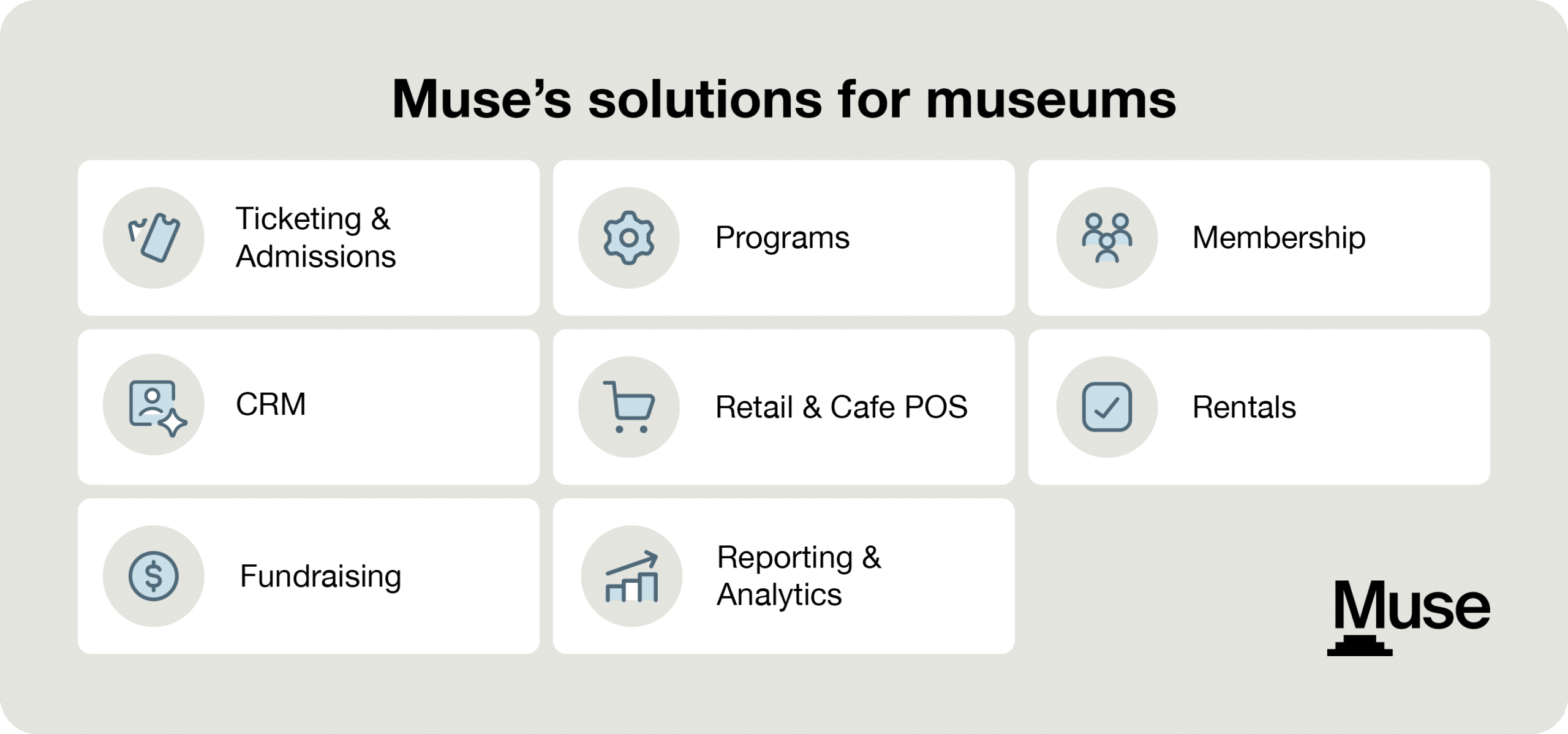
That’s where Muse comes in. Muse brings the full range of museum operations onto one shared platform with these solutions:
Ticketing & Admissions. Real-time attendance and capacity data give your planning team an accurate baseline to set realistic visitation and revenue goals.
CRM. Muse consolidates engagement data for every visitor, member, and donor, so your assessment starts from one shared record instead of a partial view from each department.
Programs. Running camps, classes, and workshops on one platform means your program numbers appear alongside the rest of your operational data, not in a separate spreadsheet.
Retail & Café POS. Many museums have donor prospects sitting in their retail and café data. Because Muse ties purchase history to the same constituent record as membership and giving, your team can spot those prospects for future giving conversations, adding more clarity to your development goals.
Fundraising. Muse identifies prospects from visitor and member data, so your strategic development goals can be backed by a data-driven pipeline.
Membership. Automatic renewals and benefit tracking make it easy to monitor retention progress against the specific strategic planning metrics.
Rentals. Venue bookings feed into the same constituent record, so rental clients show up in your membership and giving pipeline instead of a separate database.
Reporting & Analytics. Dashboards provide insights on visits, revenue, membership, and fundraising, so a quarterly strategic review does not start with pulling data from four separate systems.
A museum strategic plan that can hold up over time requires grounded data, shared departmental ownership, and technology built to handle that complex infrastructure. When your front-line staff, executive leadership, and operational systems share the same data points and reporting tools, you can create a comprehensive, accurate, and helpful picture of what you can do today to secure your future success.
Learn more about museum operations with these additional resources: